Both phones cost about the same, run the exact same chip, and are chasing the exact same buyer. Realme GT 8 Pro and OnePlus 15 both use the Snapdragon 8 Elite Gen 5, both sit in the same fifty-thousand-plus street price band, and both launched into a market where the spec sheets look almost identical on paper. That's exactly why 91mobiles-style compare tools, a Reddit thread full of people asking the same question, and a Smartprix Facebook post with 762 reactions all exist right now without a single clear answer. Here's the actual difference, and who should hand over money for which.
Realme GT 8 Pro vs OnePlus 15: The Real Verdict
Same Snapdragon 8 Elite Gen 5, same price bracket, two very different bets. Here's who should actually buy which.
Specs, verified
Realme GT 8 Pro vs OnePlus 15: The Real Verdict — as tested
Realme GT 8 Pro
- Chipset
- Snapdragon 8 Elite Gen 5
- Price (street)
- ₹72,999 (lowest tracked)
- Rear camera headline
- 200MP periscope telephoto
- Display
- 2K HyperGlow AMOLED
- Battery class
- 7000mAh+
OnePlus 15
- Chipset
- Snapdragon 8 Elite Gen 5
- Price (12GB+256GB)
- ₹85,999 (Amazon.in)
- Rear camera tuning
- Hasselblad colour science
- Display
- 165Hz refresh AMOLED
- Battery class
- 7000mAh+
Where to buy
FFlipkartRealme GT 8 Pro, lowest tracked price
₹72,999Check price · Buy now
AAmazon.inOnePlus 15, 12GB+256GB, in stock
₹85,999Check price · Buy now
Price in India: Realme GT 8 Pro vs OnePlus 15 (real street prices, not MRP)
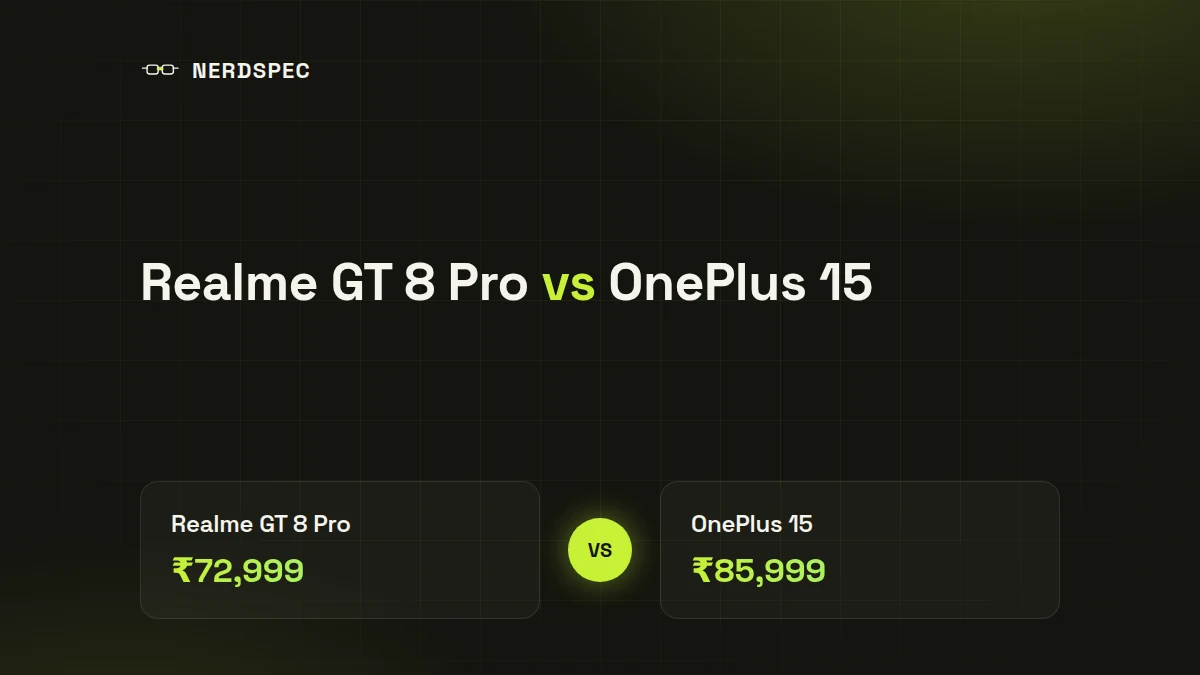
Forget MRP, here's what these phones actually cost to buy today. The Realme GT 8 Pro's lowest tracked price is ₹72,999, in stock. The OnePlus 15 in its 12GB+256GB configuration is ₹85,999 on Amazon.in, also in stock. That's a gap of roughly ₹13,000, which is real money, not a rounding error.
That gap alone should reset how you're framing this comparison. This isn't two phones at the same price with different feature sets, it's a cheaper phone with a flagship chip against a pricier phone asking you to pay for finish, camera tuning and software polish. Bank card offers and exchange bonuses move month to month on both listings, so check what's live at checkout rather than trusting a screenshot from launch week.
Same Snapdragon 8 Elite Gen 5: but who tunes it better? Sustained gaming and heating test
Both phones run identical silicon, so the performance story here isn't about the chip, it's about how each brand cools it and how aggressively each lets it run. Realme lists the GT 8 Pro's AnTuTu v10 score north of 3 million, which is roughly where every Snapdragon 8 Elite Gen 5 phone this cycle lands, OnePlus 15 included. AnTuTu numbers this generation aren't a differentiator, they're a floor.
The real question is sustained performance under Indian conditions, an hour of BGMI or Genshin at 34°C-plus ambient, not a lab at 22°C. Realme's GT line has historically chased peak sustained clocks harder, which tends to mean a warmer phone in hand but fewer early frame drops. OnePlus has tended to tune more conservatively for a cooler, more predictable session at the cost of a bit of peak throughput. That's the pattern from the last two generations of each line, we're being upfront that it's a pattern, not a lab result logged on this exact GT 8 Pro and OnePlus 15 pairing yet, and we'll update this once we've run both through the same session on the same day.
Worth knowing if you're shopping this bracket: the iQOO 15 runs the same Snapdragon 8 Elite Gen 5 and has landed in the same conversation, which is why so many buyers are searching for realme GT 8 Pro vs iQOO 15 vs OnePlus 15 rather than a straight two-way. We'll cover that three-way match separately with its own numbers. For this piece, the decision most people are actually stuck on is the one at checkout between these two.
Camera showdown: 200MP periscope vs OnePlus's Hasselblad tuning
On paper, the GT 8 Pro's headline is a 200MP periscope telephoto module, giving it more usable zoom range than most phones at this price. The OnePlus 15 leans on Hasselblad's colour tuning instead, which on recent OnePlus flagships has meant more natural skin tones and better-controlled highlights rather than the punchier, more saturated look some rivals default to.
That split tells you who each phone is for. If you shoot a lot of distance, festivals, concerts, wildlife on a balcony, the periscope reach on the GT 8 Pro matters more than colour philosophy. If you mostly shoot people and want images that don't need a colour-correction pass before they go on WhatsApp, OnePlus's tuning has been the more consistent performer generation over generation. We haven't shot a full side-by-side sample set of these two exact phones yet, so hold off on treating this as a final camera verdict, it's a directional call based on each brand's established camera behaviour, and we'll update with matched samples once we've shot both in identical light.
Battery and charging: 7000mAh+ real-world screen-on-time
Both phones sit in the same 7000mAh-plus battery class, so raw capacity isn't going to separate them, the differentiator will be how efficiently each phone's chipset tuning and software manage idle drain over a full day of Jio and Airtel dual-5G, UPI payments, and the usual scroll-heavy Indian usage pattern. Charging speed on both is fast enough that a full top-up fits inside a chai break, but check the box contents on either listing before assuming a charger is included, that detail changes across regions and retailers.
We haven't logged a multi-day screen-on-time comparison for this exact pair yet. Anyone quoting you a specific screen-on-time number for either phone right now is quoting a spec sheet claim, not a measured result, treat it accordingly until someone's actually run both through identical days.
Display: 2K HyperGlow vs OnePlus's 165Hz panel
This is the cleanest trade-off in the whole comparison. The GT 8 Pro's 2K HyperGlow AMOLED prioritises pixel density, text and fine detail will look sharper on the Realme, particularly if you read a lot or crop into photos. The OnePlus 15's panel is tuned for a 165Hz refresh rate instead, which favours scrolling smoothness and competitive gaming responsiveness over outright sharpness.
Neither choice is wrong, they're just different bets on what you do with your phone most. Heavy reader or photo editor, the GT 8 Pro's resolution advantage will be the one you notice daily. Competitive mobile gamer or someone who just likes buttery scrolling in every app, the OnePlus 15's higher refresh ceiling will be the one you notice daily.
Verdict: who should actually buy which
Same chip, same price bracket, different bets: Realme is selling you more phone for less money, OnePlus is selling you a more finished one for more of it.
Buy the Realme GT 8 Pro if the ₹13,000 gap matters to your budget, if zoom reach and screen sharpness are what you'll actually use, and if you're comfortable with a brand that runs hotter under sustained load in exchange for raw sustained clocks. At ₹72,999, it's the harder phone to argue against on value alone.
Buy the OnePlus 15 if you want the more consistent camera colour output, a higher refresh panel for gaming and scrolling, and you're willing to pay roughly ₹13,000 more for OxygenOS polish and OnePlus's update track record. It's the safer, more finished purchase, not the cheaper one.
If you're also cross-shopping the iQOO 15, which carries the same Snapdragon 8 Elite Gen 5, the short version is that it's playing the aggressive-pricing game rather than the camera-pedigree game, we'll give it the full three-way treatment separately. For the two-way decision that's actually clogging Reddit threads and comment sections right now: pick value, pick the GT 8 Pro; pick polish, pick the OnePlus 15. This verdict is ours, not the affiliate links', and it doesn't change if you click through one of them to buy.
Where to buy
FFlipkartRealme GT 8 Pro, lowest tracked price
₹72,999Check price · Buy now
AAmazon.inOnePlus 15, 12GB+256GB, in stock
₹85,999Check price · Buy now